

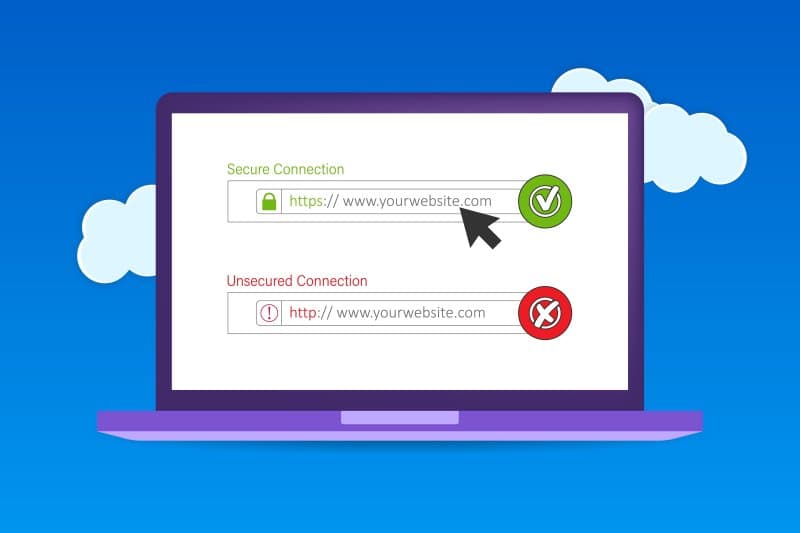
It's no secret that the internet can be a rough place. There are always bots and bad actors looking for an easy target, and sending sensitive information over an outdated network is just asking for trouble—even if the website itself looks totally fine. If you're serious about protecting your business and your own identity, getting a handle on the difference between HTTP and HTTPS is where you need to start.
Understanding exactly what HTTP is requires looking at the raw foundation of the internet. It is the core communication system that dictates how messages are formatted and physically transmitted between a web browser and a server. When you type a web address, this protocol fetches the text and images.
However, this foundational protocol was engineered without a single thought for modern security. It transmits every piece of data in completely exposed, readable plaintext. If you submit a password over this unencrypted protocol, any cybercriminal lurking on the network can easily read your credentials as if they were public property.
HTTPS is a cryptographic upgrade to the original system. It takes the exposed plaintext data of standard HTTP and wraps it inside an impenetrable layer of advanced encryption using strict TLS or SSL security network protocols designed to protect data.
This security mechanism completely obliterates the ability for outside actors to spy on your web traffic. Even if a highly sophisticated hacker intercepts your connection, the encrypted data looks like randomized, unreadable gibberish. Utilizing this protocol is an absolute, non-negotiable mandate for anyone handling credit cards or sensitive user data.
You cannot secure a digital network without tearing down and analyzing the discrepancies between these two web systems. Here is exactly how they stack up when exposed to the hostile forces of the modern open internet.
| Security Metric | Standard HTTP | Secure HTTPS |
| Data Encryption | Completely non-existent. Network traffic flows in vulnerable, readable, clear text. | enforced. All transmitted data is cryptographically scrambled and locked. |
| Port Assignment | Defaults to Port 80, a heavily targeted and heavily monitored attack vector. | Utilizes Port 443, mathematically engineered and reserved for secure traffic. |
| Authentication | Zero validation. You cannot prove the server you connect to is actually legitimate. | Requires an active SSL certificate to verify the server's identity. |
| Data Integrity | Files can be secretly altered or injected by hackers while in transit. | Cryptographic hashing prevents any undetected data tampering or injection. |
Mastering the mechanical operations of the HTTP and HTTPS protocols is absolutely mandatory for preventing massive corporate data breaches. You must execute these core networking principles to survive the online landscape.
Secure connections do not just happen instantly; they require an digital handshake where the client and server negotiate encryption keys before any actual website data is ever permitted to move.
You cannot just invent a secure status for your domain. Elite, third-party Certificate Authorities (CAs) must rigorously vet your business and issue digital certificates to legally validate your server identity to the world.
Google algorithms hunt down and penalize unsecured sites. Running the modern secure protocol is a forced, unbending requirement if you want to rank anywhere near the first page of search results.
Deploying a secure website connection requires you to abandon outdated infrastructure and enforce modern cryptographic standards. Follow these rigid operational mandates to permanently lock down your server.
You must acquire and install a robust security certificate from a trusted authority to validate your server's true identity to any incoming client web browser.
Do not leave your old plaintext web pages alive. You must redirect all incoming unsecured traffic directly to the secure ports using permanent 301 server-level redirects.
HTTP Strict Transport Security is a server directive that forces modern browsers to strictly communicate with your domain over secure channels, permanently rejecting unencrypted connection attempts.
The digital war for data privacy is ongoing, and running unsecured network architecture is a massive liability that will eventually destroy your operations. You cannot afford to leave your digital communications exposed to the hostile open internet. The debate of HTTP vs HTTPS is completely over; the secure protocol has won unconditionally.
Many falsely believe encryption slows down load times. In reality, modern performance upgrades like the HTTP/2 protocol strictly require a secure connection to function. This allows secure sites to multiplex data, pushing assets faster and actually outperforming the speed of legacy unencrypted connections.
Beyond technical defense, secure protocols are legally mandated for specific industries. The Payment Card Industry Data Security Standard (PCI-DSS) dictates that any business processing credit cards must utilize encryption. Operating on plaintext violates compliance, resulting in massive fines and destroyed merchant accounts.
Absolutely. Even if you do not collect passwords, Internet Service Providers and malicious hackers can hijack unencrypted transit lines to inject their own advertisements, tracking scripts, or malware directly into your plaintext HTML, heavily compromising your innocent readers.
No, it does not provide absolute invisibility. While the exact pages, passwords, and messages you type are cryptographically locked, your ISP can still see the main domain you are connecting to via leaked DNS requests and the Server Name Indication (SNI) routing data.
Yes. Encryption strictly locks down the data while it is moving through the internet pipes. It does absolutely nothing to defend your physical server from database injections, weak administrative passwords, or outdated software plugins that hackers exploit to breach the site directly.
This content was created by AI