

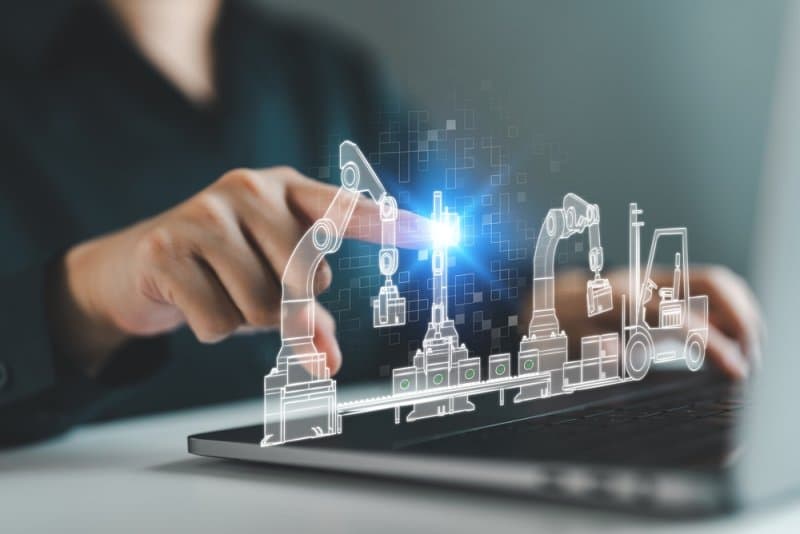
Testing a change on a jet engine sounds like a bad idea. Testing it on a copy of the jet engine? Much better. That’s the basic pitch behind digital twins technology, and it’s why so many factories and hospitals are paying attention. Below, we’ll cover how it works, where it’s used, and whether the hype holds up.
A digital twin is a virtual stand-in for something real. It could be a pump, a person, or a whole supply chain. People often call them virtual replicas of physical systems, and that’s fair, but the key bit is that the replica keeps changing as the original does. So what is digital twin technology? Mostly sensors, data, and software, all feeding one model.
Think of it as a loop. Real asset, data, model, decision, and back again. Each pass makes the model a little more accurate, which is why twins tend to get more useful the longer they run. It sounds simple, and in principle it is.
Sensors sit on the real machine and track things like temperature, vibration, and speed. Internet of Things connections push those readings to the cloud within seconds. Historical records get added too, so the twin has memory. Without good data, nothing else works.
Software turns the stream of numbers into a model, often a 3D one. Engineers can rotate it, zoom in, and look inside parts they’d never reach on the real machine. Nobody has to shut anything down to do it, which matters when every idle hour costs money.
Now the testing starts. Real-time simulation technology lets a team change a setting, raise the load, or skip a repair and see what happens next. Add machine learning, and the model starts flagging likely failures before anyone notices a problem.
Twins come in different sizes. Some copy one gear. Others copy an entire factory or a company’s workflow. Knowing the types of digital twins saves you from building something too big or too small, so here’s a quick table to start from.
| Type | What It Copies | Typical Use |
| Component | A single part, like a gear | Wear tracking |
| Asset | A full product, like a pump | Performance checks |
| System | Assets working together | Line balancing |
| Process | A complete workflow | Output planning |
Digital twin use cases cover a lot of ground. The rule of thumb is simple. If testing something real is costly, slow, or risky, a twin probably has a role. Digital twin applications are spreading fast, but two areas show the idea best.
A digital twin in manufacturing helps plants try new layouts and spot slow machines without touching the line. Automotive engineers use them to test prototypes, refine designs, and plan repairs before a breakdown. Fewer surprises on the floor. That’s the whole goal.
With a digital twin in healthcare, hospitals can model beds, equipment, and staff schedules to see where patients get stuck. There’s a more ambitious side too. Researchers are building twins of human organs to explore how a person might respond to a treatment.
LG Electronics used a twin at its Changwon factory in Korea and saw productivity rise 17% and product quality improve 70%, while energy use fell 30%. On a much bigger scale, NASA is developing Earth system twins to model climate and human activity.
The benefits of digital twins mostly come down to time and money. You find problems early, when they’re cheap. Not every company will see all of the gains below, but most will see at least one. Here are the big ones.
Testing a virtual prototype is cheaper than building ten physical ones. Flaws surface before mass production, so there’s less rework and products reach customers sooner. For smaller firms, that speed can be the difference between keeping up and falling behind.
Early warnings on worn parts mean repairs happen when you choose, not when the machine decides. Wind turbines and jet engines are classic cases, since surprise failures there cost a fortune. Operators can schedule the work, order parts in advance, and skip the 2 a.m. emergency call.
Twins also show where energy and materials get wasted. Fix those spots, and the bills drop along with emissions. Retailers use similar models to study how shoppers move around a store. Small layout changes can mean less lighting, less heating, and less clutter.
Choosing digital twin software depends on what you already run. Azure Digital Twins, AWS IoT TwinMaker, and IBM Maximo Application Suite come up most often. Begin with a single asset. If that pays off, expand.
The future of digital twins looks bright, at least on paper. One forecast puts the market near $34 billion in 2026 and about $385 billion by 2034. AI will likely make twins better at prediction. That fits the bigger digital trends we’re seeing across business.
Digital twins technology won’t replace good judgement, but it does give teams a safer place to be wrong. Fix the problem on screen, then fix it for real. If you’re curious, pick one machine or one process and start there.
Close, but no. A simulation usually runs on set data and never touches the real world. A twin stays hooked up to a real asset through sensors, so it keeps updating as conditions change.
Not always, though it’s becoming the norm. Older twins got by without it. Today, machine learning helps them learn from the real asset, catch failures early, and suggest fixes. That beats a static model.
Yes, and it doesn’t have to be a big project. Cloud tools have made things cheaper, so a small team can model one machine first, see whether it pays off, and add sensors later.
No. A twin is a working copy of something real that you study. Virtual reality drops you into a made-up world through a headset. Some teams mix the two for a closer look.
Michael Grieves applied the idea to manufacturing and formally announced it in 2002. But NASA was using matching spacecraft copies for study in the 1960s, so the thinking goes back much further.
This content was created by AI