

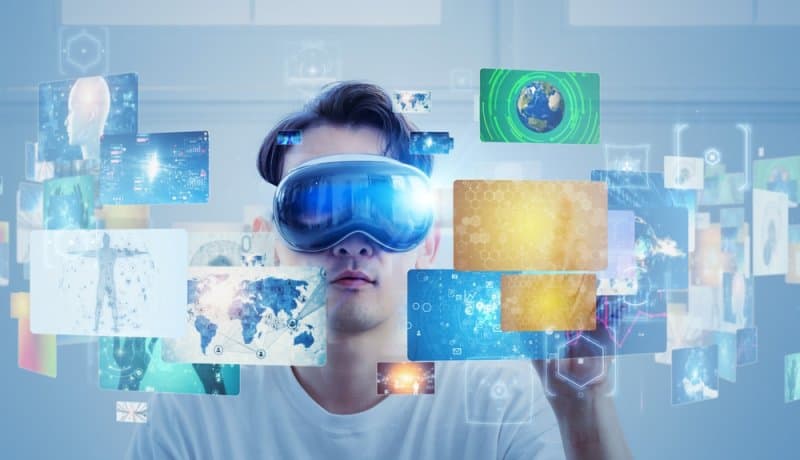
Recent advances in spatial computing can also provide users with an experience through digital content that moves with them instead of using a screen. This allows users to merge physical surroundings with digital content for a more immersive experience.
Gaming, industrial training, and reality as it happened—this is just some of the emerging world opened up by XR.
Spatial computing is a technology that enables computers to perceive physical environments and overlay them with digital content. It makes it possible to manipulate virtual objects as if they were present in the real world. Smart glasses, sensors, mixed reality headsets, and cameras are used to facilitate this.
Since we primarily use screens, keyboards, and touch controls, it adds physical movements, gestures, and voice control. If you're designing a living room, you'll be able to virtually place a sofa in your actual home and get a sense of it before ordering a piece of furniture.
For example, digital assistants and virtual reality headsets are already moving toward applications that understand what is around you. Devices recognize and analyze objects, surfaces, distances, and motion—and AI crunches the information so your digital assistant or headset reacts to your environment.
Next, spatial computing technology enables the positioning of digital objects in a three-dimensional space. The physical space can be explored, and digital objects can be scaled, moved around, and manipulated using gestures and voice commands. Cloud computing and advanced processors enable complex processing demands and high performance.
We are beginning to see some real-world applications of physical and digital integration that are incredibly useful to companies. This document lists some of those examples.
Physicians will be able to explore 3D models of organs, analyze difficult spatial computing use cases, or prepare for surgery with spatial computing apps. In addition, students could try out various techniques in virtual environments without risking actual patient lives.
These AR experiences can assist medical professionals in comprehending complex data more effectively and enhance their pre-procedural planning.
Educational institutions and training providers can employ 3D models in an interactive format to explain more complex topics. Their pupils, students, and apprentices attending science-based courses such as astronomy, biology and engineering can benefit by inspecting virtual objects.
Another can carry out genuine training exercises that employees could use to practice handling machines, safety, and other tasks within the workplace.
Store visitors can also use spatial computing to see how furniture, lighting or artworks will look in their homes before buying.
Designers have the ability to design digital room layouts, test different arrangements, and present realistic layouts to their clients before a project begins.
Plants can utilize digital twins for constructing virtual models of machinery, equipment, and plant facilities. Maintenance instructions, identification of equipment faults, and guidance can be viewed by workers without having to look at manuals.
Such spatial computing applications can also help to reduce errors, enhance maintenance planning, and simplify complex industrial operations.
Why Spatial Computing—Beyond visually appealing experiences, the value of spatial computing is when information is more useful for everyday life.
Some important advantages include:
These features make it attractive for both recreational and business purposes.
This is one of the most interesting comparisons you will come across, as it deals with two concepts that are very much similar but not identical.
R, or virtual reality, produces an entirely virtual environment that replaces your perspective of the physical world. Typically, you get to wear a headset that allows you to "walk" into a virtual space or play games or simulations.
Spatial computing is a broader term. It could be a physical-digital hybrid environment, the physical world fused with digital elements. It also refers to augmented reality (AR), mixed reality (MR), and virtual reality (VR). Therefore, virtual reality can be a part of spatial computing, but it is not the only part.
However, it may impact the time frame in which spatial computing challenges spread technically.
Important concerns to consider are:
Overcoming these challenges will be the key to making much of the spatial computing technology accessible to users everywhere.
The future of spatial computing may be more immersive by going deeper with AI, wearables, and connected environments. As hardware gets smaller and processing power increases, we'll be able to access digital experiences without the large headsets.
Other types of digital twins might be used more often in the workplace to track equipment, validate new product designs, and improve the working environment. Augmented reality experiences could become increasingly prevalent when it comes to browsing, orientation, learning, and communicating.
If they go ahead, the spatial computing apps could be a normal part of life, not just something that people think of as being for gaming or dedicated equipment.
Spatial computing offers a new way to augment the physical world with digital experiences. Used in healthcare, education, retail, and manufacturing, spatial computing is already demonstrating its potential to solve real-world challenges and provide new and engaging experiences.
Despite still being constrained by costs, privacy, and technical challenges, spatial computing has a promising future ahead—especially as the tech evolves and AI and wearables make more strides.
No, spatial computing is how computers interact with real-world environments, unlike the metaverse, which involves a network of connected digital spaces where people can hang out, work, and do things virtually.
Many tech firms are working in this industry, like Apple, Microsoft, Meta, and Google. They produce software, mixed reality headsets, smart glasses, and other tools for working with digital experiences.
No, generally you don't need to know programming to use spatial computing devices. Several apps have fairly straightforward gesture and voice controls, with some plug-and-play experiences. Developers, however, require certain technical skills to be able to create more sophisticated spatial apps.
Yes, some spatial computing features can be enabled on smartphones, tablets, cameras, and other sensors that are equipped with sensors. For instance, mobile AR applications can detect surfaces and overlay content on the real world without a dedicated headset.
Here are four ways small business owners can use this technology: Use this tech to demonstrate, build products, train employees, and share products with customers. Furniture stores, design showrooms, and educators/training companies could especially benefit from showing customers what products will look like or how to use them before buying.
This content was created by AI